
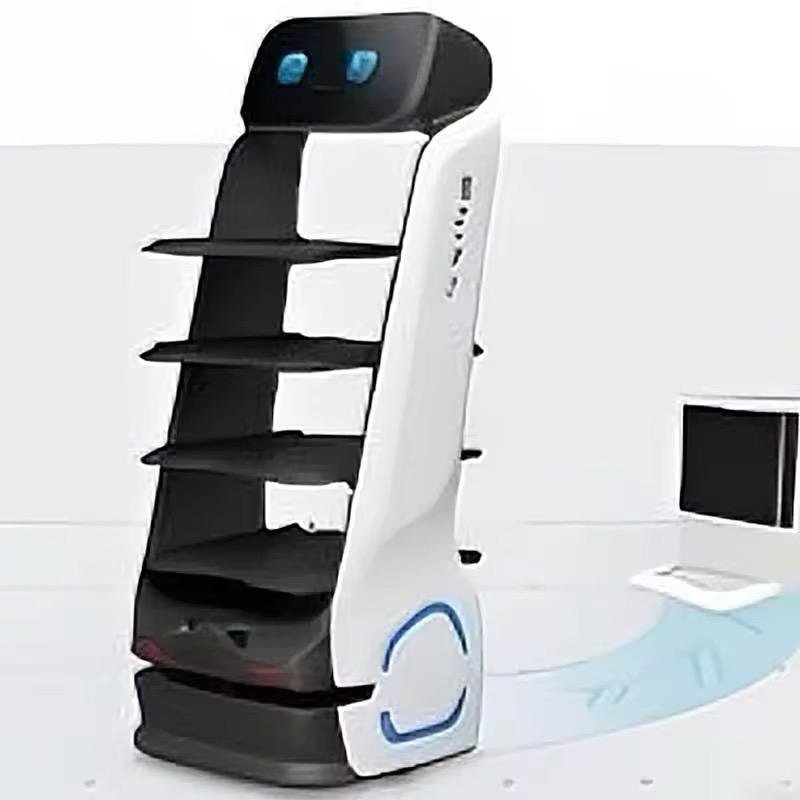
Price: $20668
The core value of commercial intelligent food delivery robots has evolved from the original “means of transport” to a “digital employee” integrating autonomous movement, intelligent interaction and multi-machine collaboration. Its fundamental role is to solve the structural pain points of “three highs and one low” (high rent, high manpower, high ingredients, low gross profit) for the catering industry, so as to reduce costs and increase efficiency, improve consumption experience and data operation.
📊 Analysis of core functional modules
Functional dimension, key technology, specific role and user value
Accurate perception and positioning. Multi-sensor integration of SLAM technology (vision + laser + IMU) realizes centimeter-level positioning (±5cm). Without coding, the 30-meter-high lobby can also operate stably; it can identify glass, low obstacles and other complex environments.
Safe and autonomous movement, predictive obstacle avoidance algorithm + vehicle-level suspension, upgraded from “stop when encountering an obstacle” to “predicting detour”, improving traffic efficiency; the independent suspension system ensures that the soup is not spilled and reduces food losses.
High-efficiency carrying capacity, large-capacity cabin + modular design, maximum load capacity 42kg, volume 190L, single-machine average daily distribution volume 400-600 plates (2-3 times that of labor); support heating/refrigeration module to ensure the quality of meals.
Intelligent human-computer interaction, large language model + multi-modal perception, support multiple rounds of natural dialogue, dish recommendation, active customer attraction; improve the fun of dining through expression/voice interaction.
Group intelligent collaboration, cloud brain + unified scheduling platform, break down brand barriers, realize heterogeneous robot (production + distribution + cleaning) collaborative operation, and move from “single-machine intelligence” to “group intelligence”.
🏢 Scenario application and business value
· Catering stores (indoor distribution): undertake high-intensity food delivery and tableware recycling. The average monthly cost of a robot is about 2,000-3,000 yuan, which is only half of the labor, and can solve the problem of “difficult recruitment”. Representative models such as Purdue “Bella” and Qinglang T series.
· Box and cross-floor: For private boxes or hotel scenarios, support independent elevators and cross-floor distribution. For example, Purdue’s “SWIFTbot NEO” is equipped with an AI voice command system, which adapts to the whole process service of the box.
· Marketing diversion: “Take the initiative to attract customers” at the door in your spare time, introduce preferential activities through big model rhetoric, and improve the conversion rate of entering the store. For example, Orion’s Starry Sky “Fortune Leopard” focuses on “deliving meals when busy and soliciting customers when idle”.
· The whole process is unmanned: In the Zhongguancun Forum in 2026, the robot restaurant has realized the automation of the whole process from ordering, production to distribution, and customers can pick up the meal 2 minutes after placing an order.
💡 Selection and benefit suggestions
Commercial food delivery robots have become a necessary tool for catering upgrading, not a “gimmick”. Operators can pay attention to three points when selecting models:
1. Look at the navigation ability: give priority to the multi-sensor fusion SLAM scheme to ensure that you don’t get lost in a complex environment with high dynamics and a lot of glass.
2. Look at interactive intelligence: Robots equipped with large language models can act as “shopping guides”, bringing additional marketing value, not just executing commands.
3. Calculate the economic account: In addition to direct human replacement (the average monthly cost is within 3,000 yuan), the comprehensive return brought by marketing diversion and data precipitation should also be considered.
If you are considering introducing a food delivery robot, you can tell me the type of restaurant (such as hot pot restaurant, restaurant, fast food) and the approximate area, and I can help you recommend more specific models and configuration plans.
7.Precise obstacle avoidance modular tray system IP67 rated 5 kg payload 6-axis robot waiter




Reviews
There are no reviews yet.