
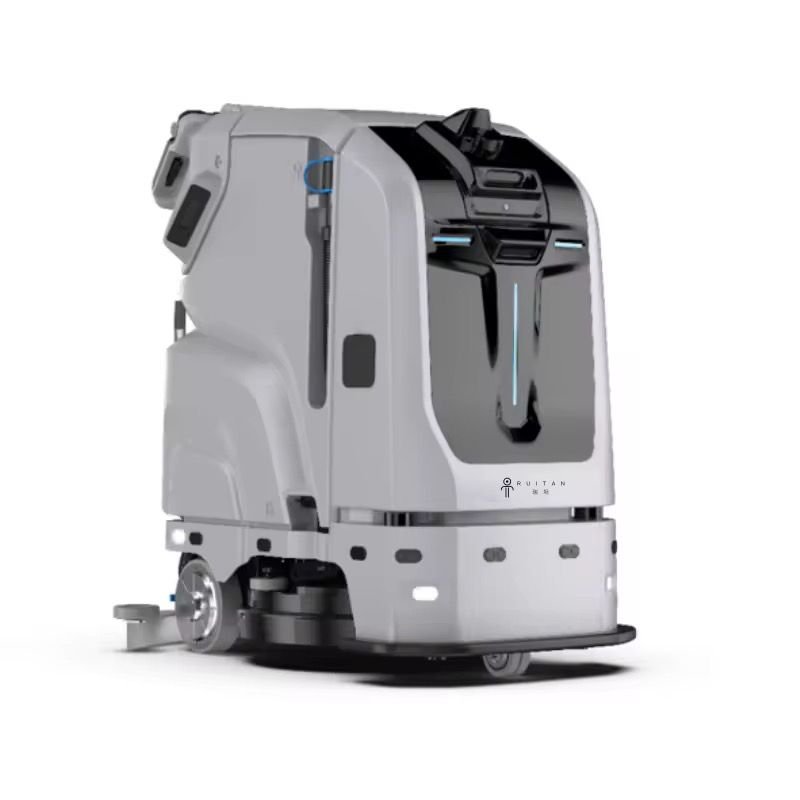
Price: $298500
1. Core functions: How do “washing, mopping and sucking” work together?
The stains in industrial scenes are often mixed with oil, iron shavings and dust, which cannot be handled by a single function. These three functions are synchronized and complementary in actual execution:
· Floor washing (core): Strongly peel off stubborn stains such as oil stains and tire marks on the ground through high-speed rotating plate brush or roller brush with water and detergent. The subsequent water-absorbing pick-up will immediately pump the sewage back to the sewage tank to realize “wash and dry”, leaving no water stains, and avoid the risk of slipping.
· Vacuuming (supplement): Before washing the floor or when sweeping alone, use a large suction fan (some models can reach more than 23500Pa) to suck out metal debris, dust and particles to prevent these impurities from scratching the ground or blocking pipes when washing the floor.
· Mopping/dust pushing (fine treatment): In the lightly polluted area or after washing and drying the floor, the dust push module adsorbs fine dust, which plays the role of polishing and brightening and keeping the ground clean.
2. Core carrier: What pain points does the “big water tank” solve?
The industrial scene has a large area (tens of thousands of square meters). If the water tank is too small, the robot will frequently go back and forth to replenish water, which will greatly reduce the efficiency.
· Extend the duration of a single operation: the large water tank (commonly 70L-120L, even up to 310L) allows robots to clean for hours at a time without manual intervention.
· Automatic addition/drainage: High-end models (such as Gaoxian, iTR, Purdue CC1) support optional workstations. After the task, the robot will automatically connect to the base station to complete sewage discharge and water, and truly realize “unmanned” continuous operation.
3. Core role: cost reduction, efficiency increase and standardization
In addition to the cleaning itself, the core value of this kind of machine is reflected in the operational level:
· Replace high-load labor: the average daily cleaning area of a machine can reach 8000-17000m2, which is equivalent to the workload of 2-3 cleaners. It solves the problem of “difficult recruitment and large flow of personnel” in industrial plants, allowing manual work to do more fine corner maintenance.
· Standardized cleaning quality: The machine will not be lazy and can cover every corner strictly according to the preset path to avoid the randomness and omission of manual cleaning.
· Safety and environmental compliance: In electronics factories, food factories and other scenarios with high cleanliness requirements, the machine can operate automatically on a regular time, reduce the dust pollution caused by the entry and exit of personnel, and can remove fine dust particles to meet the requirements of occupational health protection.
4. Purchase perspective: the difference between different “integration” schemes
According to the previous round of communication, here are two technical routes for your reference:
· Floor washing all-in-one machine (such as UBTECH M79, iTR 300): characterized by large water tank (>100L) and high-pressure plate brush, focusing on heavy pollution scenarios (workshop, garage). Usually, “plate brush to wash the floor + water absorption” is completed synchronously, and the cleanliness is the highest.
· Separate type of sweeping and washing (such as Purdue CC1, Covos K1): the water tank is moderate (15L-30L), but it integrates the side-brush dust collection function. Sweep first and then wash, which is suitable for light industrial scenarios with a lot of dust and less oil pollution (such as warehouses and corridors).
40.Fully automatic global positioning system/RTK self-propelled mowing robot 1600W 24V 4-stroke obstacle avoidance household DIY industrial grade




Reviews
There are no reviews yet.